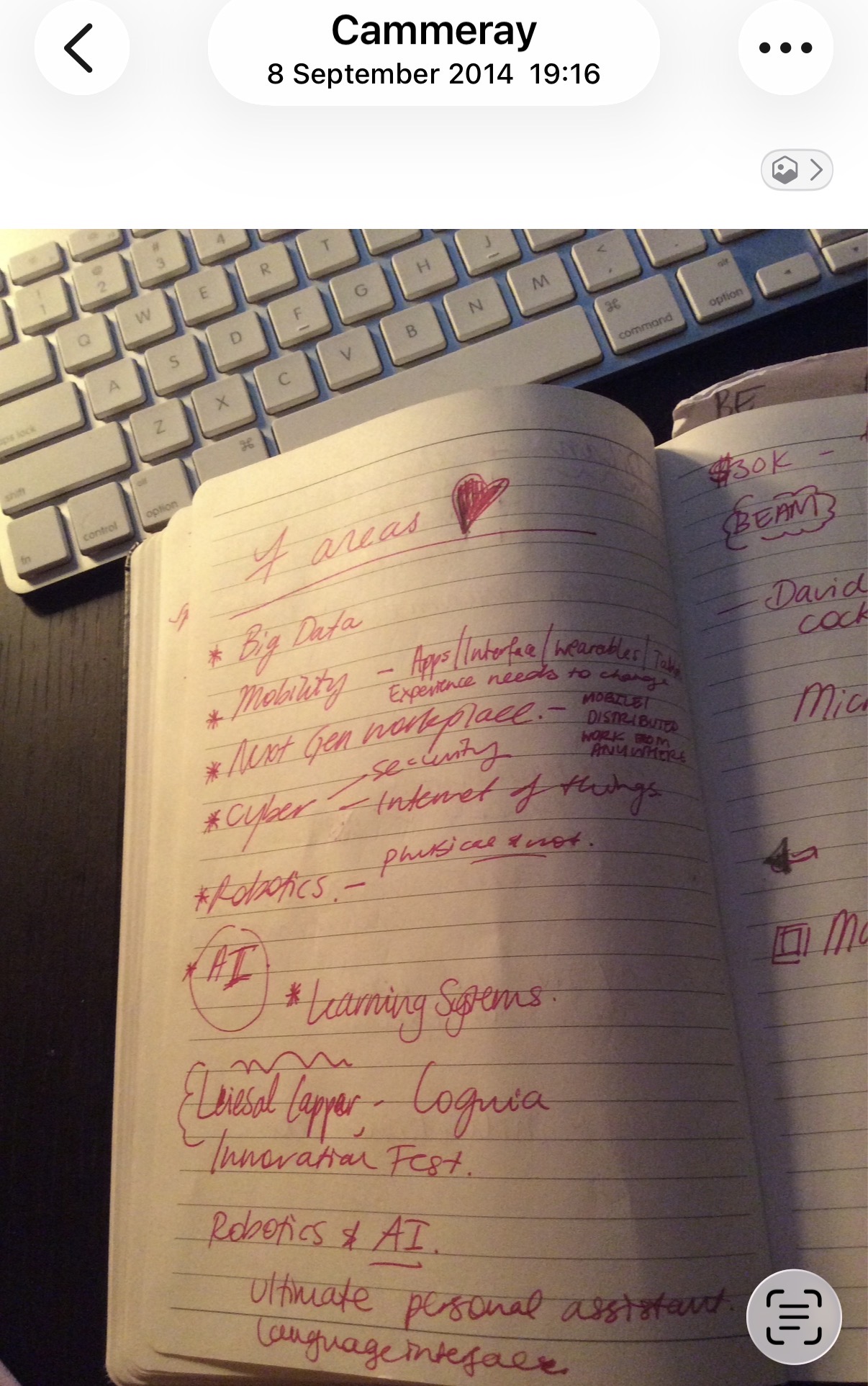
I found the notebook a few weeks ago. Dated 8 September 2014. Written in red pen at a desk in Cammeray, Sydney. I was mid-career, deep in transformation leadership at one of Australia's biggest banks, and I was sitting in a room full of people trying to map the future.
On the page in front of me, I had written: "4 areas." Then I listed them. Big Data. Mobility. Next Gen Workplace. Cyber security and the Internet of Things. Robotics.
And then, circled — unmistakably, deliberately circled — the word: AI. With a note underneath: Learning Systems.
At the bottom of the page, I had written something that stopped me cold when I read it twelve years later:
"Robotics & AI — ultimate personal assistant. Language interface."
I had just described ChatGPT. In 2014.
What I Was Actually Seeing
I want to be precise here, because this isn't about claiming some prophetic genius. It's about something more important: I was in the right rooms, asking the right questions, and I was paying attention.
The notes from that day referenced a Cognica Innovation Festival — an event where practitioners, technologists, and strategists were mapping the forces shaping the next decade. These weren't fringe ideas. They were signals being discussed seriously by serious people.
Here's what was on that page, faithfully transcribed from my 2014 handwriting:
- *Big Data — the foundation everything else would be built on
- *Mobility — apps, interfaces, wearables, tablets. Experience needs to change.
- *Next Gen Workplace — mobile, distributed, work from anywhere
- *Cyber — security + Internet of Things, physical and digital
- *Robotics — physical and not
- *AI (circled) — Learning Systems → ultimate personal assistant, language interface
Every single one of those forces arrived exactly as predicted. The distributed workplace? We lived it in 2020. Wearables? On your wrist right now. IoT? In your fridge, your car, your city. And AI with a language interface? You're probably reading this having already had three conversations with one today.
The Future Arrived Exactly As Predicted
What strikes me most looking back isn't that we got it right. It's how long it took the mainstream to catch up — and how disorienting that arrival was for people who hadn't been watching.
When ChatGPT launched in November 2022, the dominant reaction was shock. Panic. Existential dread. Headlines screamed about jobs disappearing overnight. Organisations scrambled. Leaders who had been heads-down in operational delivery suddenly found themselves managing a force they had never seen coming.
But some of us had been watching for a decade. Not because we were smarter — but because we had been inside transformation long enough to understand that technology doesn't arrive suddenly. It compounds quietly, and then it tips.
I spent those years working at the intersection of human experience and technological change. Leading design teams. Running transformation programs. Asking, over and over: what does this mean for the people on the other side of it? That question — the human experience question — turned out to be the most important one anyone could be asking.
So What Am I Seeing Now?
Here's the part that matters most. Because if the last decade taught me anything, it's this: the signals are always visible to those who are paying attention.
And right now, I'm watching several things converge that most leaders are still treating as separate problems:
1. The gap between AI capability and human readiness is widening, fast. The tools are extraordinary. The average person's ability to use them intentionally — to direct them, rather than just react to them — is lagging badly. This is the skills crisis nobody is naming correctly.
2. AI is being implemented without a human experience framework. Organisations are deploying AI into customer journeys, employee workflows, and decision-making processes without asking the fundamental question: what does this feel like for the human on the other side? The cost of that oversight will compound.
3. The leaders who will thrive aren't the ones who know the most about AI. They're the ones who know how to think alongside it — who bring judgment, values, creativity, and genuine curiosity to the partnership. I call this being a Wonder Conductor: the human who holds the baton, who decides what gets played and how.
The question was never "will AI replace us?" The question has always been "who will learn to conduct it?"
In 2014, I was circling the word AI in a notebook. In 2026, I'm spending every working day helping leaders, teams, and organisations answer the question that notebook was already asking: how do we stay human at the centre of this?
The future arrived. And it arrived exactly as predicted. The only question now is whether you're the one directing it — or the one being directed.
I know which one I'm choosing. And I'd love to help you choose it too.