No time for AI? Gone for coffee.
By Sarah Pirie-Nally
“I know I need to do this, but I don’t have time.”
It’s one of the most common things people say to me about AI. Usually, they say it with the expression of someone whose brain already has forty-seven tabs open, three of them are playing music, and nobody can work out where the sound is coming from.
I understand. When you’re running a business, looking after people, keeping clients happy and trying to remember why you walked into the kitchen, learning something new can feel like a wildly unreasonable suggestion.
And meanwhile, I’m over here at the coffee shop, figuring out how to reinvest all the time my agents have saved me.
Some of that time is going back into growing my business. Some is becoming room to think, create and connect. And some is simply becoming a coffee I get to enjoy while it’s still hot.
That small moment captures something I have been exploring for years through my book, The Time Abundance Mindset: how we design our days, what support we allow ourselves, and what we actually want the space for.
AI has given me another way to put that philosophy into practice.
The difficult part is that learning asks for time before it gives any back.
When you are busy, you make decisions against the pressure of today. A client needs something. Your inbox is expanding. The task in front of you has a deadline. Learning how to change the way you work feels optional beside all of that.
So you do the familiar thing again, even when it is exhausting. You tell yourself you will explore AI when things settle down.
I have learned to be suspicious of that mythical quiet week. A business grows. Children enter a new stage. A project finishes and another begins. Waiting for a completely clear runway can become a very effective way of postponing change indefinitely.
The useful place to begin is much smaller: one recurring piece of work that is taking more from you than it should.
Perhaps it is assembling information before a meeting. Perhaps it is turning your rough notes into a usable first draft. Perhaps it is repeatedly hunting through documents for the same answers.
You can begin by changing one task, then deciding whether the change actually helps.
My thinking about time abundance began with 1,440 minutes.
That is how many minutes there are in a day. In the early versions of The Time Abundance Mindset, I invited people to examine where those minutes went, almost as if they were looking at a bank statement.
What were they spending? What had become automatic? Where was time disappearing into habits, unnecessary work or arrangements that no longer suited their lives?
Four ideas became central to the way I approached this: observe your time before trying to improve it; know your non-negotiables; build enough structure to support you while leaving room for change; and keep experimenting as your life evolves.
Those ideas still matter to me. They have travelled through different seasons of motherhood, work, relationships and business.
But my understanding has grown. There can be an empty afternoon in the diary and absolutely nothing left in the person expected to enjoy it.
Capacity matters. Energy matters. Support matters. The amount you are holding in your head matters.
A full life also contains obligations you cannot simply delete, and access to help is uneven. Time abundance has to work with that reality. Telling an exhausted person to adopt a better attitude is a poor substitute for helping them change the load they are carrying.
That is why I am interested in systems that give something back: fewer things to remember, less repeated preparation, a clearer next step, or another pair of capable hands.
AI can be part of that support.
The work around the work is where I see useful possibilities.
Think about everything that happens before you can do the thing you are actually good at.
You find the notes, locate the document, collect the background, remind yourself what was agreed, put the information into a usable shape and then work out where to begin.
By the time you arrive at the meaningful part, you have already spent some of your best attention.
A well-designed AI workflow might prepare a briefing for your review, organise material you have supplied, or turn meeting notes into a draft action list. An agent with the right access and a clearly defined job can take on parts of that preparation across connected tools.
The value depends on whether the result is accurate and useful, and how much effort it takes to supervise.
A fast draft that needs a complete rewrite has barely moved you forward. A neat summary that misses the important detail can create more work. I want the whole task to become easier, including the checking and correcting.
That is the standard I care about when I talk about getting time back.
For a business owner, even a modest improvement can create a valuable opening. A piece of work stops occupying the first part of every morning. You arrive at a conversation prepared. You can give a promising idea your attention before the day becomes reactive.
The coffee shop starts to make sense.
The next decision is where the reclaimed time goes.
This is where my Time Abundance Mindset becomes especially relevant to working with AI.
It is very easy to treat every saved hour as an invitation to accept another obligation. You automate something, increase your output, take on more, and find yourself just as stretched with a slightly more impressive collection of software subscriptions.
I know the temptation. I love my work. Creating, teaching and building things give me joy and meaning. There will always be another idea I want to explore.
I have even written in the book about finally creating more capacity and responding by writing more books. Apparently, my instinct when presented with some space was to commission myself a publishing schedule.
The lesson was uncomfortable and useful: I needed to get better at choosing what to do with the room I had created.
That choice can absolutely include growth. It can include a new offer, a deeper client relationship or a project you have wanted to develop for years. It can also include an afternoon with your children, a conversation with your partner, or enough rest to enjoy the life you are working so hard to build.
You are allowed to want all of those things across different seasons.
Growing a business deserves some of your best thinking.
A business can consume your attention through hundreds of small, legitimate demands. Each one feels important in the moment. Collectively, they can squeeze out the work that shapes what the business becomes.
Where do you want to take it? What do your customers need that you have not properly addressed? Which offer needs improving? Which partnership deserves a real conversation? What would you build if you could give the idea an uninterrupted hour?
Those are questions I want room to sit with.
Reinvesting time into growth might mean improving a customer experience rather than rushing straight to the next sale. It might mean developing an idea properly before announcing it. It might mean noticing that the thing everyone asks you for could become a useful new service.
There is a difference in the quality of attention you bring when you have enough room to consider a decision.
That is part of what I am buying back when my agents take useful work off my plate. I get to spend more of my energy on the parts of the business that need my experience, imagination and judgement.
And sometimes those decisions are easier to think about with a coffee, away from the familiar pull of the inbox.
In the book, I use an exercise called the Stage Test.
It begins by looking at what is currently occupying your mental space and separating the coordination from the caring.
Remembering, tracking, organising and sequencing can often be supported by a system. Deciding what matters, noticing how someone is doing, taking responsibility and building relationships still ask something of us as people.
In a business, you might use AI to prepare the background for a client conversation. You still need to listen when the client tells you what is really happening. You might ask it to organise customer feedback. You still have to decide which problem deserves your attention and what you are willing to do about it.
The Stage Test also asks you to name what the freed space is for before it appears.
That is a surprisingly powerful instruction. “Save time” is vague enough for almost anything to claim the result. “Make room to improve our onboarding experience on Thursday morning” gives the space a purpose.
So does “finish work in time to be properly present with my family.”
The question I return to in the book is: “Will Future Sarah thank me?”
It helps me think beyond the immediate satisfaction of ticking something off. Setting up a repeatable workflow can be a gift to the person I will be next week. So can deciding that a task no longer needs to happen.
If you are reading this with a very full diary, start with one small experiment.
Here is a practical way to apply those ideas to AI this week:
Notice one repeated drain on your time. Choose a task you understand well and do often enough to recognise a good result. Write down what it involves and roughly how long it takes. Include the preparation and the checking.
Decide what still needs doing. Before introducing a tool, look at the task itself. Could you stop it, simplify it or do it less often? Give AI a useful job with a clear purpose.
Define the handover. Specify the information it can use, the result you want and where you need to review the work. For example: prepare a draft follow-up from these notes for my approval, using only the details provided and flagging anything unclear. Start with material you are comfortable sharing in the tool you have chosen.
Check the actual return. Compare the complete process with how you worked before. Count setup, review, corrections and upkeep. Notice whether it reduced your mental load as well as your time. Improve the workflow or leave it behind if it creates more effort than it removes.
Give the reclaimed space a destination. Put something specific in the diary: developing your offer, calling a potential collaborator, taking a proper lunch break or finishing earlier. Choose something you want the change to make possible.
This is an experiment you can learn from. One useful result gives you evidence and confidence for the next decision.
You do not need to build my whole desktop to begin.
You also get to decide what a successful day feels like.
I think this is one of the most interesting questions available to us as we bring AI into our businesses and lives.
We can measure how much work moves through a system. We can also ask whether the people using it have more clarity, more room to make good decisions and more capacity for the things they care about.
For me, time abundance has become a very practical form of agency. I want a say in how my attention is spent. I want to grow a business I love while being able to experience the life around it.
The systems help. The support helps. My agents help. I still have to choose what I am building towards.
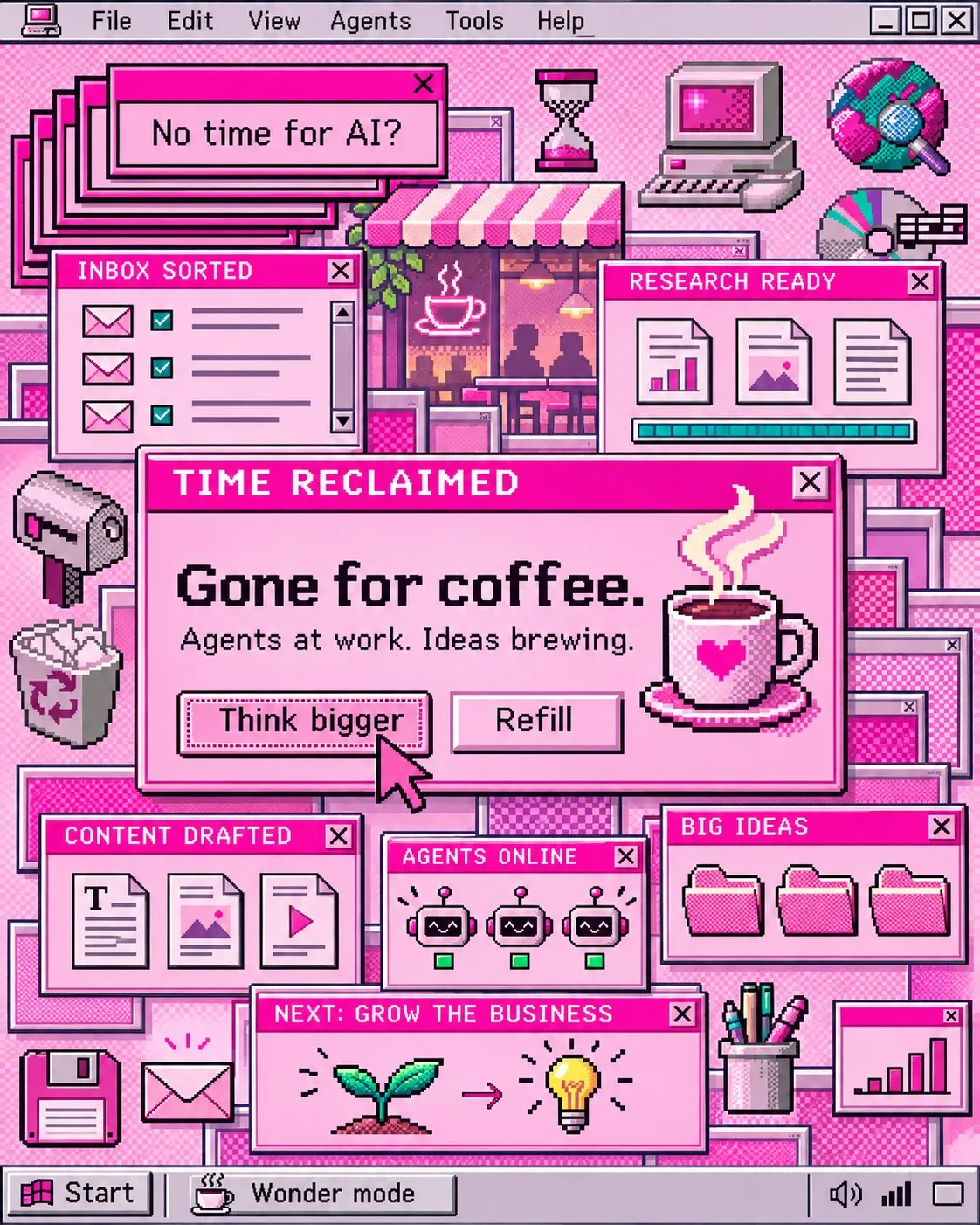
That is why I love the image of an overflowing pink desktop with a “Gone for coffee” message in the middle. There is plenty happening, and the person responsible has some room to think about what happens next.
The question that used to be “Where will I find the time?” becomes “What do I want to do with the time I have got back?”
I would like more people to experience that shift.
If this is the kind of abundance you want, explore it with me in The Time Abundance Mindset: Life Design for the Beautifully Overcommitted.
In the book, I share how my thinking evolved from counting minutes to designing for capacity, support and the life I actually want to live. It includes practical exercises for examining your time, understanding your non-negotiables, applying the Stage Test and making room for the wishes that can get buried underneath the to-do list.
It is for the person who has plenty they want to do and would like more support, choice and enjoyment in the doing.
Get your copy on Amazon: Paperback · Kindle
And when you get some time back, give yourself a moment to choose what comes next.
Preferably over a very good coffee. ☕️