What is a Chief Design Officer? And why does it matter in the age of AI?
The question is whether we should build it this way, whether people will trust it, and who is holding the whole experience together.
For a long time, people heard design and thought: logos. Websites. Apps. Making things look good.
Those things matter. But they are not the job of a Chief Design Officer.
A CDO sits at the intersection of customer, business, technology and people and asks a more consequential question:
“Are we designing the right thing, and will humans actually understand, trust and use it?”
I have led design inside large transformations, including as Chief Design Officer at ASB Bank. One thing I learned quickly is that you can have brilliant technology, a perfectly sensible business case and an enormous transformation budget, and still create an experience people hate.
That happens when a solution is designed in fragments. Product teams optimise the product. Technology teams optimise the platform. Operations teams optimise the process. Marketing optimises the message. Everyone is doing their job, but no one is responsible for the experience a real person actually has moving through all of it.
Design is not decoration. It is decision quality.
A good CDO helps an organisation see the consequences of a decision before those consequences turn up in a customer complaint, a frontline workaround, a risk register or an expensive re-platforming project.
They connect the dots between strategy, customer experience, technology, operations, capability and human behaviour. They make sure the thing being built makes sense in the messy, emotional, real-world context of a person trying to get something done.
The CDO lens
- Are we solving a real human problem, or simply demonstrating that we can use a new tool?
- Will people understand what is happening, trust it, and know what to do when it gets something wrong?
- Where does AI genuinely remove friction, and where is a human relationship part of the value?
- What is this system optimising for, and whose experience might it quietly make worse?
- Who is designing the whole experience, rather than everyone optimising their own little piece of it?
AI makes this role more important, not less.
Suddenly organisations can create more. More interfaces. More automation. More agents. More personalised journeys. More decisions made by machines. More things sitting between a customer and a human being.
The constraint is no longer simply, “Can we build it?” Increasingly, it is: “Should we build it this way?”
Where does AI genuinely improve the customer journey? Where should a human remain in the loop? What happens when the AI gets it wrong? Does the customer understand what is happening? Does it remove friction, or simply automate bad friction faster?
These are not “design polish” questions. They are strategic, operational, reputational and ethical questions. And they need to be addressed while a system is still a decision, not after it has become an incident.
Four moves that make AI useful and trusted.
01
Start with the journey, not the tool
Map the moment a customer or employee is trying to move through. Then identify the friction worth removing. AI is an option, not the starting point.
02
Design human hand-offs on purpose
A human in the loop is not a vague reassurance. It is a clear role, a visible escalation path and a useful moment for judgement, care or accountability.
03
Make the system legible
People do not need a lecture on the model. They do need to understand what is happening, what the system can and cannot do, and what choices they still have.
04
Build the feedback loop before scale
A good pilot tells you what to improve. A bad one simply automates bad friction at speed. Build a way to hear from customers and frontline teams before rolling out wider.
Not every organisation needs a full-time CDO.
But as AI moves from experiments into actual customer experiences, more leadership teams will need this capability in the room.
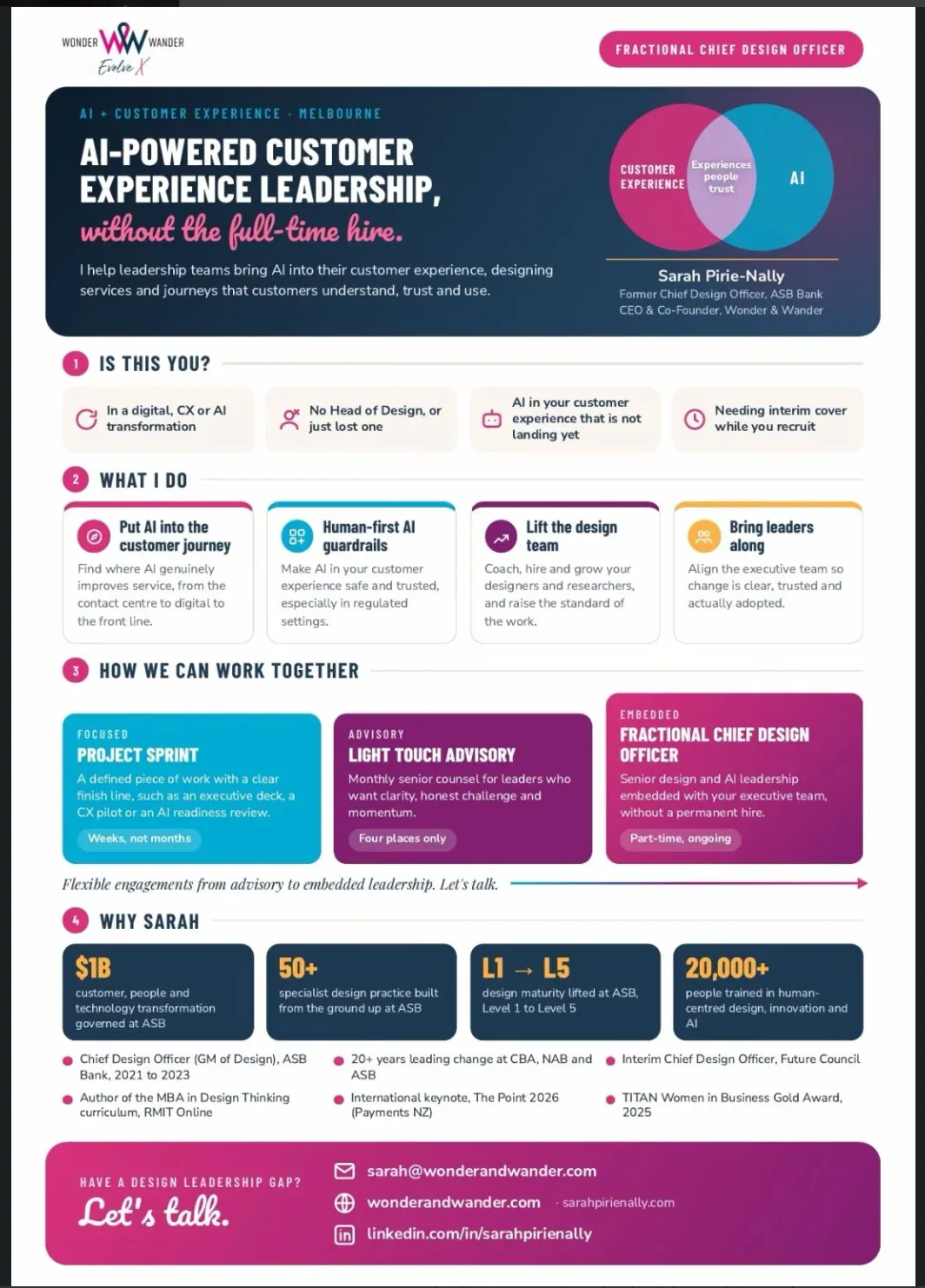
Sometimes that looks like a focused project sprint: an executive deck, a service or customer-journey pilot, an AI-readiness review or a design challenge that needs a clear finish line.
Sometimes it is light-touch advisory: honest senior counsel as leaders decide where to focus, what to protect and how to maintain momentum.
And sometimes it is a Fractional Chief Design Officer: senior design and AI leadership embedded alongside an executive team, without a permanent full-time hire.
Design + AI leadership
Bring me the messy question.
If you are navigating an AI, customer experience or design leadership challenge, I help leaders turn ambition into an experience people can actually understand, trust and use.
Work with Sarah