What I Taught 100 Marketers About AI Dashboards (And What I Learned)
I've spent years watching talented marketers drown in spreadsheets.
They're copying numbers from one tab to another, building the same weekly report on a Sunday night, and calling it "analysis." It's not. It's data janitorial work. And I wanted to show them there's another way.
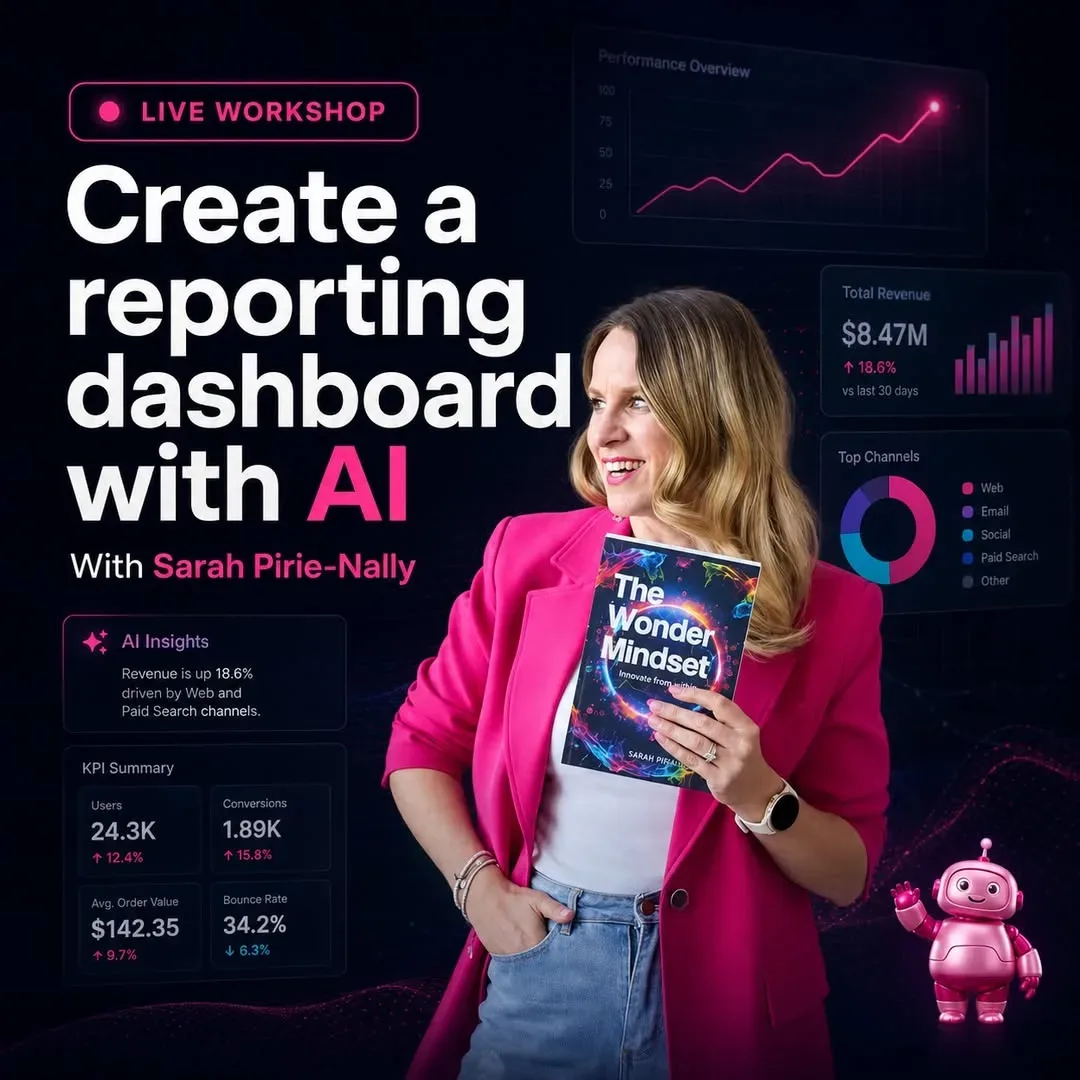
Yesterday I ran "AI-Powered Dashboards for Marketers" live, and I want to share everything we covered, because the frameworks we worked through are genuinely changing how my clients run their reporting.
Are You Using a Tool or an Agent?
The first thing I asked the room was: what's the difference between a tool and an agent?
Most people said "tools are simpler." That's not wrong, but it misses the point. Here's how I frame it:
| Tool | Agent | |
|---|---|---|
| What it does | Executes one task on demand | Reasons, plans, and acts across multiple steps |
| Who drives it | You prompt it every time | It can initiate and chain tasks |
| Example | ChatGPT answering a question | An AI that pulls your data, spots an anomaly, and drafts a Slack message |
| Best for | Specific, bounded tasks | Ongoing monitoring and multi-step workflows |
Most marketers are using AI as a tool. That's fine. But the real leverage, the part that saves hours every week, comes when you start building agents.
The RACI Prompt Framework
Every great AI output starts with a great prompt. And most marketers are prompting like it's 2022.
The RACI framework is what I teach now. Every prompt should answer four things:
R, Role. Who is the AI playing? ("You are a senior performance marketing analyst...")
A, Action. What exactly should it do? ("Analyse the following weekly metrics...")
C, Context. What does it need to know? ("This is data for an e-commerce brand with a target ROAS of 3x...")
I, Intent. What's the output for? ("I need to present this to a non-technical CEO...")
When all four elements are in your prompt, the output quality jumps. It's not magic, it's just giving the AI enough to do its job properly.
5 Prompts You Can Use This Week
We built five prompt templates live in the workshop. Here they are:
1. Weekly Performance Summary
You are a senior marketing analyst. Summarise the following weekly data for an e-commerce brand. Highlight top 3 wins, top 3 concerns, and one unexpected insight. Write in plain English for a non-technical CMO. Data: [paste data]
2. Audience Fatigue Detector
You are a paid social strategist. Review the following creative performance data. Identify any signs of audience fatigue, declining CTR, rising frequency, CPM spikes. Flag creative assets that need refreshing. Data: [paste data]
3. Creative Performance Report
You are a creative strategist. Analyse the following ad performance data. Group by creative format and hook type. Identify which creative approaches are outperforming benchmarks and explain why. Data: [paste data]
4. Budget Pacing Alert
You are a media buyer. Review the following spend data against our monthly budget targets. Flag any channels pacing ahead or behind. Recommend reallocation if needed. Budget: [X] Data: [paste data]
5. Anomaly Alert
You are a data analyst. Review the following daily metrics. Identify any anomalies, spikes or drops outside normal variance. For each anomaly, suggest a likely cause and recommended action. Data: [paste data]
The 3-Layer Dashboard Stack
The biggest mindset shift in the room happened when we talked about dashboard architecture. Most people think of a dashboard as a pretty chart. It's not.
A properly built AI dashboard has three layers:
Layer 1, Data In. Your live data sources connected automatically. Google Ads, Meta, GA4, your CRM. No manual exports.
Layer 2, AI Layer. The intelligence layer that sits on top of your data. It runs your prompts, spots patterns, generates summaries.
Layer 3, Output. What you actually see and share. A clean dashboard, automated reports, Slack alerts, email digests.
When these three layers work together, your Monday morning looks very different.
The Monday Morning Ritual
Here's the exact process I walked the room through, what your first hour on Monday looks like when your dashboard is working properly. Runtime: approximately 10 minutes. Used to take 4 to 6 hours.
- Open your dashboard (it's already updated, no manual pulls)
- Review the AI-generated weekly summary
- Check flagged anomalies
- Read the performance narrative (written by AI, reviewed by you)
- Identify the top 3 priorities for the week
- Share the summary with your team (one click)
- Get on with actual strategy
What I Believe About AI and Marketing
Through the workshop, four principles kept surfacing. I want to name them explicitly.
1. AI should reduce cognitive load, not add to it. If your AI setup is making you think harder, it's set up wrong.
2. Prompts are skills. The marketers who will thrive are the ones who learn to prompt well, not just use AI, but direct it.
3. Dashboards should talk to you. Static charts are a 2019 solution. Your dashboard should surface what matters, unprompted.
4. Speed creates space for strategy. When reporting is automated, you get your brain back. That's where the real marketing work happens.
The biggest takeaway from yesterday wasn't a framework or a prompt template. It was this: the marketers who are going to win over the next five years aren't the ones who work the hardest, they're the ones who build the best systems.
Download the full workshop takeaway guide, free PDF
Sarah Pirie-Nally is the founder of Wonder & Wander, a human-centred AI and leadership ecosystem. She works with founders, leaders, and marketers navigating the AI era. wonderandwander.com