The Slippery Slope from Vibe Coding to Hardcore Development
We've all been there. You open Cursor, Claude, or Grok, type a loose prompt like "make a sleek dashboard that feels calm and productive," hit enter, and, boom, working code appears. No boilerplate hell. No wrestling with syntax at 2 a.m. It feels like magic.
This is vibe coding: building by feel, intuition, and iteration rather than rigorous engineering. It's playful, fast, and dangerously addictive.
For multihyphenates, designers who code, writers who ship products, creators who wear founder hats, AI has been a godsend. It collapses the distance between idea and artefact. But that same magic creates a slippery slope into hardcore development territory, where "it just works" turns into "why the hell doesn't this scale?"
AI is both dream and nightmare, and the difference comes down to knowing your boundaries in the software development lifecycle, design thinking, and AI-augmented workflows.
The Slippery Slope
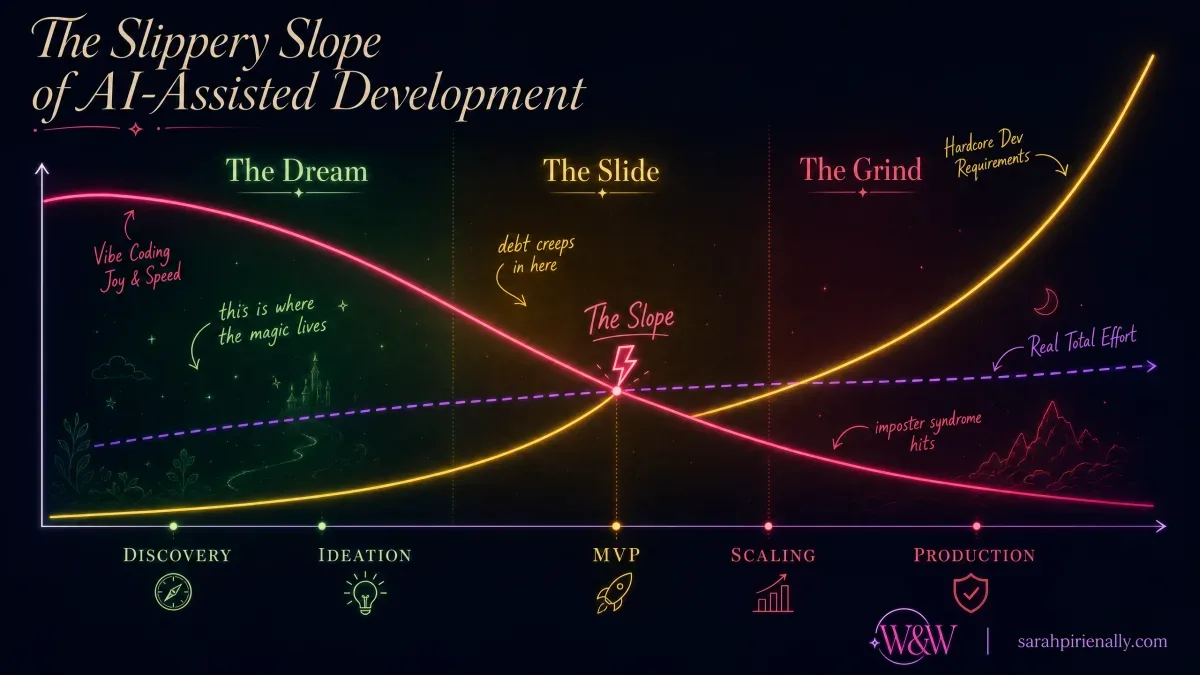
The Dream, The Slide, The Grind, three phases every AI-assisted builder moves through.
Phase 1: The Dream: Vibe Coding Feels Like Superpowers
Early in a project, AI is pure joy:
Rapid ideation and prototyping. You describe user flows in natural language and get React components, Tailwind styles, or even full-stack starters. Design thinking's "empathise → define → ideate" stages accelerate dramatically.
Low-friction experimentation. Multihyphenates can test ten different product directions in a weekend instead of a month.
Skill democratisation. You don't need to memorise every API or framework. AI handles the scaffolding so you can focus on taste, user experience, and business logic.
This phase maps beautifully to the early product lifecycle: discovery, ideation, and MVP building. AI acts as a tireless pair programmer who never gets tired or judgmental. For solo creators or small teams, it's genuinely transformative.
Phase 2: The Slippery Slope: When Vibe Coding Stops Scaling
The problems creep in subtly.
Technical debt snowballs. Vibe-coded code often works for the happy path but collapses under edge cases, performance loads, or security review. AI hallucinates patterns that look plausible but violate best practices. You ship fast... then spend weeks refactoring.
Debugging becomes detective work. When something breaks, the AI didn't document its assumptions. You're left tracing logic you didn't deeply understand. The "vibe" evaporates and you're suddenly doing hardcore debugging, stack traces, logs, profilers, race conditions.
Context window and drift. As the codebase grows, prompts lose fidelity. What started as elegant vibe turns into brittle, duplicated, or inconsistent architecture. You hit the limits of what a single developer (even augmented) can hold in their head.
Production realities hit. Authentication, observability, CI/CD, compliance, database migrations, accessibility, internationalisation, these aren't vibe-friendly. They require systematic thinking, trade-off analysis, and deep domain knowledge.
This is where AI shifts from fun to frustrating. The same tool that let you move at lightspeed now surfaces your knowledge gaps at scale.
Phase 3: The Nightmare: AI as Both Crutch and Mirror
For multihyphenates, this phase feels personal.
The Dream: You can ship polished products faster than ever. You stay in flow. Your hybrid skill set (design + strategy + light coding) becomes viable for real revenue.
The Nightmare: You realise how shallow some of your understanding is. Imposter syndrome creeps in when you can't explain why the code works, only that it does. Teams or users start depending on your "vibe" product, and the fragility becomes a liability. Burnout follows when every new feature requires descending into hardcore territory you never fully levelled up in.
AI exposes the boundary problem. Many multihyphenates treat it like a magic wand instead of a force multiplier. The skill pill here is painful but necessary: you must deliberately practise the parts AI can't own, taste, systems thinking, responsibility, and architectural judgment.
Your AI Operating System: The Framework
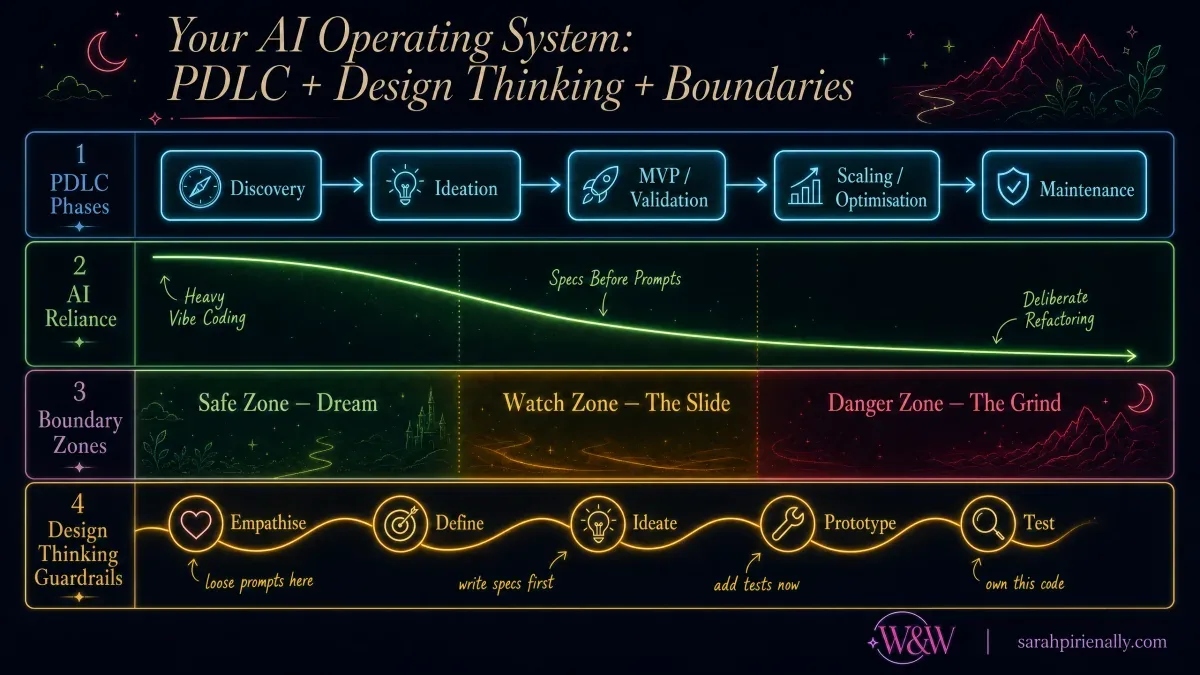
Map your phase, match your tooling, and let design thinking run as guardrails across everything.
The Skill Pill: Integrating Design Thinking, PDLC, and AI Boundaries
Here's a practical framework for staying in the dream while preparing for the nightmare.
1. Know Your PDLC Phase and Match Tooling
| Phase | Mode | AI Approach |
|---|---|---|
| Discovery / Ideation | Heavy vibe | Loose prompts, rapid prototyping |
| MVP / Validation | Hybrid | AI + manual review, add tests |
| Scaling / Optimisation | Hardcore | Write specs before prompting |
| Maintenance | Deliberate | Documentation, refactoring sprints |
2. Design Thinking as Guardrails
Treat AI output like user research data, raw material that still needs synthesis. Always loop back to:
- Who is this for?
- What problem are we really solving?
- What are the trade-offs?
- How might this break delightfully or catastrophically?
3. Build Deliberate Boundaries
Prompt discipline. Move from vague vibes ("make it nice") to precise specs ("implement rate limiting with Redis, handle 5,000 concurrent users, include audit logging").
Code ownership rituals. After AI generates something, explain it out loud or in comments. Refactor at least 30% yourself.
Learning sprints. Pick one hardcore topic per quarter (authentication, databases, performance) and build a small project without AI first.
Version control as truth. Use Git strategically. Branch for experiments. Main branch requires human understanding.
4. The Multihyphenate Advantage
Your breadth is your edge, if you develop depth in critical areas. AI lets you cover more surface area, but only deliberate practice lets you defend the territory you claim. The best multihyphenate products combine deep human taste with reliable systems, not just impressive demos.
Final Thought: Ride the Slope, Don't Fall Off It
AI hasn't eliminated the need for hardcore development, it's just changed when and how you apply it. Vibe coding is the on-ramp, not the destination. The creators who thrive will be those who treat AI as an amplifier of taste and judgment rather than a replacement for them.
The slope is slippery by design. Embrace the fun early phase. Respect the grind that follows. Learn your boundaries ruthlessly. That's how multihyphenates turn AI from a party trick into a genuine competitive advantage.
Made by Sarah Pirie-Nally and Manus AI